
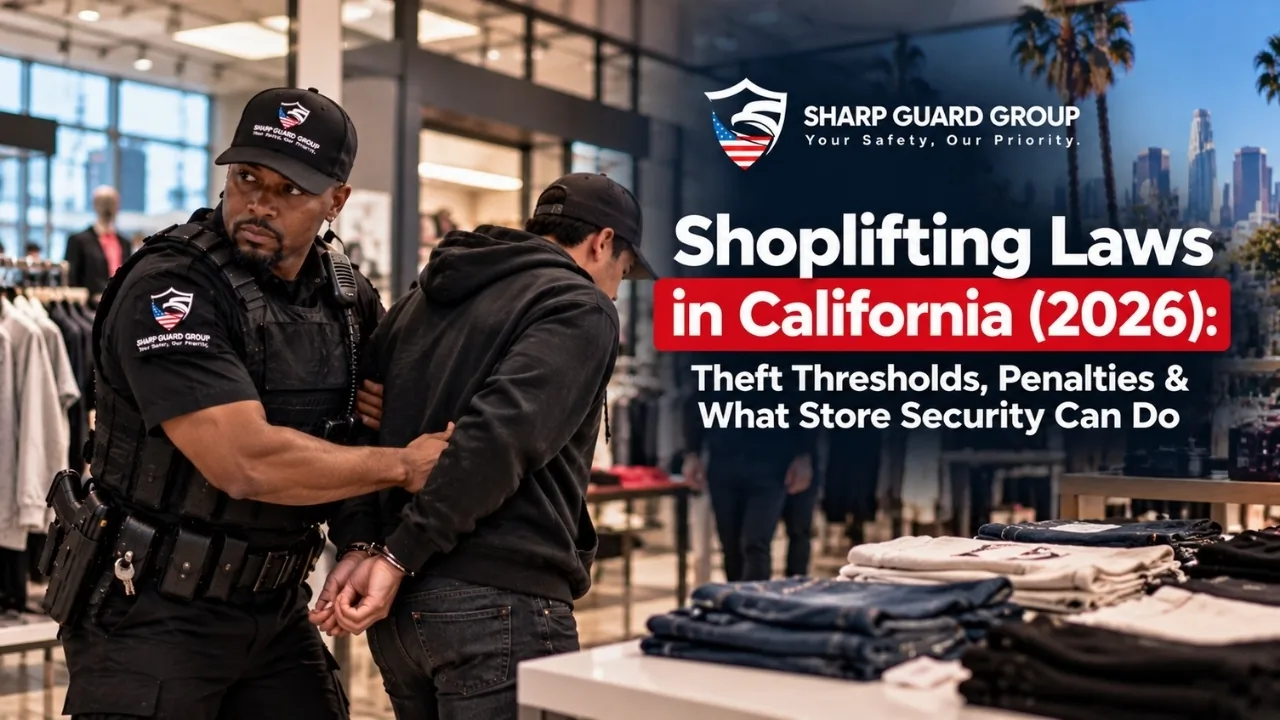
Published October 26, 2026 · Sharp Guard Group (BSIS PPO #18098)
You have likely asked yourself what the rules are, if you operate a store in California. Over the years, it felt to many owners that shoplifting was no longer of much concern to police or prosecutors. This is no longer the case and shoplifting laws California retailers no longer look as they did. In 2024, new laws and a new proposition, Proposition 36, provided new tools to stores and police. However, your security team is not infinite, and it can cost you a lot to take a step in the wrong direction. This is a walk through of thresholds, penalties and what can be done by store security specifically. We shall make it simple and straightforward, as we summarize our officers.
What Is Shoplifting in California?
California considers shoplifting as a crime on its own in the Penal code 459.5. It involves going into a store when there are people working in the store and stealing less than $950. Be aware of intent pieces, as prosecutors have to demonstrate that the person intended to steal. Covering up things in a bag, taking off labels, passing registers can be indicative. In the meantime, over 950 will be classified as grand theft according to the Penal Code 487.
The $950 Threshold, Explained
This $950 line has influenced the California theft law since Prop 47 of 2014. At or below that amount, shoplifting and petty theft are normally misdemeanors. But above that line, prosecutors may do so with grand theft, occasionally a felony. Thieves took advantage of that line over the years keeping every trip to slightly under $950. The reason the rules eventually changed in late 2024 is in part that loophole.
How Proposition 36 Changed Shoplifting Penalties
In November 2024, voters voted to pass Prop 36, which came into effect December 18. It failed to hit the $950 mark, yet it bridged some gaps on its way.
Repeat Offenders Can Face Felony Charges
Felonies can be filed against habitual shoplifters of all values by the prosecutor, under Penal Code 666.1. It is used in cases of a person being convicted of two or more times of theft crimes. Notably, there is no wash out period hence even the extremely old convictions are counted.
Multiple Thefts Can Be Added Together
Penal Code 490.3 permits multiple but distinct thefts to be grouped together by the prosecutors. Five three hundred dollar robberies would be a felony grand theft. And the prosecutors do not have to demonstrate that there was one master plan that linked them all.
Smash-and-Grab Enhancements
Prop 36 introduces penalties in cases where three or more thieves steal property. Resale of stolen items on a large scale and stealing high value items may attract additional time in prison.
The 2024 Retail Theft Laws Every Store Should Know
Prior to the passage of Prop 36, a set of bills dealing with retail theft were also passed by legislators. Such laws are important to stores, although they received a lesser emphasis.
Police Can Arrest Without Seeing the Theft
AB 2943 allows officers to be able to arrest on probable cause, without seeing them shoplift. This is huge, as video and staff testimonies can be used to justify an arrest. This is however not the case with your peace officers, but with your security guards or store personnel.
Reselling Stolen Goods Is Its Own Crime
Possession of more than 950-plus stolen items to resell it may result in a maximum of three years. This is directed at the fences purchasing the merchandise of shoplifting crews and selling it online.
Organized Retail Theft Is Now Permanent Law
Organized retail theft is a type of theft in which individuals join forces to steal merchandises to be resold. It is classified as Penal Code 490.4 and it may be a misdemeanor or a felony. In 2024, legislators took away its expiration date, and hence the legislation is no longer temporary. To the stores, crews translate to increased losses, as well as increased safety risks among the employees.
Retail Theft Restraining Orders
Convicted shoplifters can be excluded by the courts out of the stores of that retailer for up to a period of two years. Also, the stores can no longer be mentioned or even fined when they report theft time and again.
Punishment on the Spot.
Here’s how shoplifting laws California prosecutors use apply to common situations today. A petty theft conviction as a misdemeanor can imply as many as six months in jail. The fines may be up to 1,000 and usually a probation or theft school is added in court.
A Real-World Example
Suppose there is a man, who has three times stolen your store 400 razors. Historically, visits resembled individual infractions that hardly had any impact at all. The three thefts amounted to $1,200 today and can be categorized into grand theft. Assuming two prior theft convictions, every visit may be a felony. None of that can work without dates, video and reports of your team.
What Store Security Can Legally Do
This is where most of the stores run into trouble, and we should be very clear. Stricter shoplifting legislation enacted by California did not provide any police authority to the private guards.
Detain Under the Merchant’s Privilege
Penal Code 490.5 allows merchants and their security guards to briefly arrest suspected shoplifters. They must have probable cause, and a reasonable length and character stop. It is permissible to use reasonable, non-deadly force, but to prevent escape or protect a person.
Ask for the Merchandise Back
Employees are able to request the individual to give the suspected items immediately. In case they refuse, employees can carry out a limited bag-search, but not a clothing-search.
Make a Citizen’s Arrest, Carefully
Citizen arrests may be made by guards, although misdemeanor shoplifting must occur in their presence. A tip or video made by a coworker is not sufficient to arrest a guard on misdemeanor. Once an individual has been arrested, the guard should transfer the individual to the police without any unnecessary delay.
Observe, Document, and Call Police
A really good report has become the greatest weapon in the hands of your guards. Clearly videoed and written notes are effective since the police can arrest on probable cause. And since thefts may be pooled, recording all the cases assists in constructing felony cases.
Shoplifting Tactics Your Staff Should Recognize
Being aware of the law assists, yet early detection of theft is what can save merchandise. Look at large-sized bags, heavy coats on hot days, and look at employees. As well, be aware of individuals who take off labels, change price labels, or hang around exits. Teams that are distracting usually have one individual to ask questions and the others fill bags. Return fraud occurs as well, when stolen goods are returned in cash or credit. Frankly speaking, an amiable welcome at the door reminds would-be thieves that they have been spotted.
Civil Demands: Recovering Losses Without Court
Most of the owners of the stores are unaware that California allows them to claim civil damages against shoplifters. Under Penal Code 490.5, adults can owe between $50 and $500, plus costs. In the case of minors, parents or guardians may be jointly liable to such damages. Keep good records, then, as civil demand letters require definite accurate records.
How to create a legitimate loss prevention plan.
Laws provide you with the means, but it is a clever plan that makes the means effective.
1. Begin with a written detention policy to comply with the existing California law and risks.
2. Second, educate the personnel about observe-and-report regulations, and determine who can arrest anyone.
3. The station trained loss prevention officers at the entrances, high-theft aisles, and fitting rooms.
4. Maintain clear records on camera and record prior to being overwritten by your system.
5. Report all the thefts, as repetition reporting now can assist in aggregation and felony.
6. Develop a rapport with the local police and any retail crime task force in the area.
Why LA Retailers Trust Sharp Guard Group
There are licensed and trained loss prevention officers that are available in Los Angeles at Sharp Guard Group. Our officers are familiar with shoplifting laws California retailers are dependent on and Prop 36 modifications. And they concentrate on deterrence, using cautious observation and reports that can stand the test of time. We assist clients to draft detention policies and educate personnel on how to respond safely. Our group guards grocery shops, pharmacies, boutiques, malls and bigger retail chains. And all our schemes suit your plan, and pattern of thefts and actual budget.
FAQs
Is it a Californian felony to shoplift?
Not typically, as the majority of shoplifting below the $950 is categorized as a misdemeanor. Nevertheless, two previous theft convictions or combined thefts might result in felony charges.
Are security personnel allowed to arrest shoplifters in California?
Yes, guards can make citizen’s arrests when they personally witness the theft happen. They should then hand the individual over to the police without wasting any more time.
Are the police able to arrest a shoplifter that they did not witness?
Yes, because AB 2943, officers can arrest on shoplifting due to probable cause. So, that is why our video, names of witnesses and written reports have such importance now.
What do you mean by a civil demand letter on shoplifting?
It is a letter usually written by the lawyer of the store, which seeks civil damages following theft. These demands are permitted by California law, and tend to be between 50 and 500 plus costs.
What is the maximum length of time a suspected shoplifter can be held by a store?
An adequate time is only reasonable, and is sufficient to investigate, recover, and call police. The law does not specify a specific limit, and therefore it is always better to be shorter and better documented.
Was Prop 36 a modification of the $950 threshold?
No, the line of 950 remained as it was, but there was a change in the repeat thefts and aggregation. Practically, it complicates the way of avoiding felonies by robberies of small sums of money.
Final Thoughts
The retail theft pattern of California is not the same as it was two years ago. Felonies are meted out to repeat offenders, thefts accumulate, and police can take action on evidence. Nevertheless, the capabilities of your guards have not changed much so training is more important than ever. Being aware of the California law of shoplifting is a way of safeguarding your shop, employees, and shoppers. Sharp Guard Group can assist in making those laws a working plan. The above article is general information, and is not legal advice in your case.
Protect Your Store the Lawful Way
Call Sharp Guard Group to schedule your free loss prevention evaluation. Or get a quote online, and we will develop a plan around your store.